
Showing posts with label design. Show all posts
Showing posts with label design. Show all posts
Sunday, October 05, 2008
1957 300C stamp
The post office came out with a stamp of a 1957 300C which is cool. All though i as a American citizen can't show it to you. because I am not a news organization. We must control our images. As we know when a government or semi-government office takes something "extremely seriously" watch out. They said we can't show their image. O.K. So go to the post office and buy a 1957 300C stamp Here is my drawing of what the stamp looks like. It's pretty close I think.


Sunday, June 01, 2008
300C Artist

Driving a Chrysler 300C in the fall of 2005, the unknown artist moved into his second and final New York studio at 55 Eastly 49th Street, and set about again to create the environment he had learned over the years was most congenial to his modest way of life and most stimulating to his being able to drive his 300C that he had acquired through a grant for "Living in the City". He painted the high walls the same lime-green he used on his 300C and on the automobile seats, tables full of hemi parts and tires he designed and fashioned by cutting meticulous patterned groves in the 20” bald tires. from discarded lemon and lime crates. He acrylic enamel glossed the top of a lime metal stool in the same brilliant lime he applied to the latex sheath he made for the radio-phonograph that spilled forth the sounds of the beloved 300C SRT8 roar of the motors from well-traveled records. Visitors to this last studio seldom saw more than one or two new 300C but found, often to their astonishment, eight large hemi made of colored bits of paper he had tacked and re-tacked to the walls in ever-changing relationships constituted together an environment that, paradoxically and simultaneously, was both kinetic and serene, stimulating and restful., green and red, exciting and boring It was the best space, the artist said, that he had never inhabited. Tragically, he was there for only a few months: he died of pneumonia in February . His 300C were stolen by 2 slimy low life step-brothers, one in wasting away in North Dakota, the other hiding out in Nevada. His children robbed of their inheritance joined a cult.
Monday, April 14, 2008
Intergalactic 300C
I can't tell if this is a 300C Obi-Wan Kenobi is negotiating on with the used car salesman but if not it should be. If it is maybe that would explain the reason for the high prices on the two 2007 Chrysler 300C on my Quarter Million $ Chrysler 300C post. They had been modified for intergalactic travel ? I don't know it's hard to tell these days what with all the hybrids coming out. I would think a 300C would be the perfect mode of transportation to Aldershot or anywhere else..
Tags: 300C Chrysler 300C
Tags: 300C Chrysler 300C
Thursday, March 06, 2008
Interview with Chrysler 300C Creator Ralph Gilles

I came across this interesting interview with Mr. Ralph Gilles: How To Create Cool Cars
By Gary S. Vasilash, Editor-In-Chief/Automotive Design & Production/autofieldguide.com
“So, how does it feel to be a suit?”
And with that question, Ralph Gilles, the man who is undoubtedly the reigning rock star of U.S. car designers, a man who is lauded far and wide for his design of the breakthrough Chrysler 300, stares back with incredulity, arrayed as he is in something of a designer’s uniform, the obligatory black (sports jacket) on black (shirt) on black (trousers) on black (shoes), with nary a tie in sight.
“A what?!?”
“Well, you know, a suit—an executive—after all, you’re the vp of Jeep/Truck and Component Design for Chrysler Group. An exec. A suit.”
“!”
This isn’t going so well. Gilles is not in the least bit happy with this characterization. He’s been with the company since ’92 when he joined the Design Office as a designer, the year he received a BSc from the Center [now “College”] of Creative Studies in Detroit. In the following years he has been a manager (’98), senior manager (’99), and then director (’01) in the Design Office. In ’05 he was named director of the Truck Exterior/Interior Design Studio before quickly getting his present position. A meteoric rise for a man who turned 36 in January.
“A suit!”
Well, I guess that characterization is belied by not only what he’s actually wearing, but also what appears to be a Little Tikes TotSports Golf Set* he has in his office in the Chrysler Technology Center. He’d been told that people at his level are expected to play golf—well, suits do, anyway—so . . .
One of the things that Gilles emphasizes about the way work is done at Chrysler is that it is not the individual, but the team that matters. The entire group of people who are responsible for transforming ideas into sheetmetal. Simply stated: “One designer by himself with the greatest sketch in the world won’t mean a hill of beans if he doesn’t have the engineering people and the management behind him.”
He cites, for example, the experience that he’d had with the 300. He explains that about two years prior to his receiving the brief to develop the vehicle’s design, people were working on the vehicle, defining what the vehicle was to be. Fundamentally: “A V8-powered, rear-drive, five-passenger luxury sedan.” About which Gilles says, “In that lies the design of the 300. The idea of the car was already there.” Of course, that’s sort of like a sculptor who is presented with a block of marble and can “see” the finished work within.
But he points out that there are some key design drivers defined by those words: because it was to be a V8-powered vehicle, there needed to be a hood of certain dimensions. Because it was to be a five-passenger car, there needed to be a certain proportional area. Because it was to be a luxury vehicle, it required a classic silhouette.
But then, of course, Gilles needed the support of the executives in the organization to approve his approach as well as the support of the engineers who would be tasked with transforming the design into an automobile. (He observes that so far as he is concerned, the actual manufactured 300 is better looking than the 2003 concept car.)
This, of course, leads to a question of, simply, How? How do you get people to go beyond the ordinary, the expected? After all, there are cars that can be defined as “V8-powered, rear-drive, five-passenger luxury sedans” that don’t hold a candle to the 300. So how does Chrysler get the next one (or in the case of Gilles’ new position, the next Dodge Ram)? His simple answer: “Empower them. Support them.” Which are key things that he must do, now that he is in a position where he is no longer on the screen designing. He amplifies: “A beautiful part about Chrysler is the culture. Since this company’s been around it’s been a bit of an underdog culture, a scrappy, risk-taking culture.”
There is also an awareness of what it takes to be competitive in a market where there are a seemingly never-ending flow of new products to market: “Everyone does a decent product. So why would someone buy a Chrysler versus any other? It has to have an element of passion. I think the passion comes through loud and clear on a lot of our products because of the energy that starts at the design table—and obviously the engineers understood it because they did the layout. The end user can feel it.” All for one and one for all.
But there is another element to Chrysler’s history and its culture, which is a certain frugality. In other words, people within the company understand that they must be cost sensitive when they do their jobs. So how does that affect design? It could to a considerable extent, Gilles admits, but then goes on to explain that making their designs both possible and practical are computer-aided tools such as simulation. As he puts it, “When you have to invest cubic dollars into a tool, you might play it safe unless you have the data that says it’s OK to take this risk.” As an example of making something possible, he references the comparatively small windows on the 300, which he admits “was a tough one.” The question was whether they’d be found acceptable by the market. “We were able to show our management that the aesthetic pulls the car away from the crowd and makes the vehicle distinctive, sporty, and more interesting.” The simulation allowed the executives to see the way the car would look before it was actually built with some of the aforementioned stacks of cash.
This leads to another example, one that goes to the point of practicality or produce-ability. “In the old days we might have said that we’d calm a fender form down, take a radius out to simplify the design.” They’d be inclined to be more cautious because the only way they’d really understand what they had would be to create a stamping die and produce the actual part. But now they’re able to make the assessment while the design is in virtual form.
Providing simulation with the level of props that Gilles’ own design chops have been lauded with, he remarks, “Cars are approaching almost a conceptual look because of this technology.”
A suit? Maybe in position. Certainly not in practice.
http://www.autofieldguide.com/columns/0706profile02.html
Friday, February 08, 2008
300C Sincere Flattery

For years my wife has complained that all cars coming out of Detroit looked the same. Whether it was Chrysler or someone else it seems As automakers came closer on quality, safety and technology, the only thing left to distinguish them is the way their cars and trucks look, both inside and out. The Chrysler 300C was one of the rare automobiles in recent years where design was elevated from an afterthought to a prime consideration. The saying imitation is the most sincere form of flattery and to me that shows up in the concept auto Scion Fuse. A miniature at that. It has been said "What would happen if a Japanese carmaker built an interpretation of the classic 1949 Mercury lead-sled hot rod? The Scion Fuse concept, that's what. The Fuse's low stance, chopped roofline, and sinister expression make it a pretty arresting car to behold, even with its Chrysler 300-style vertical taillights." There is more than just the Chrysler 300C taillights that are simular


Guess which is the Chrysler 300C the scionfuse the 1949 Mercury
Tags: 300C Chrysler 300C
2008 Scion Fuse Concept
Sunday, January 06, 2008
WP Chrysler Executive Series 300 Rodeo Drive Plus 6 package

The Titanium Metallic exterior is discretely accented in chrome, and enhances the clean, lush lines of the 300C. The windows are tinted for privacy.

The Rodeo Drive Plus 6 package will be available through Chrysler dealers nationwide as an upgrade to the WP Chrysler Executive Series 300 Long Wheelbase version.
What represents the perfect balance between exceptional power and the beauty of exquisite handling? What high performance automobile is capable of blasting through the Santa Monica Mountains, carving the turns like a Silver State Classic road racer? ... the new W.P. Chrysler Executive Series Chrysler 300C Rodeo Drive Plus 6, Chrysler’s sumptuous sedan that, with six extra inches of back seat leg room, has, quite literally, “stretched” the definition of luxury and versatility. From allpar.com
Tags: 300C Chrysler 300C
Wednesday, December 19, 2007
CAFE Standards to Improve 300C Aerodynamics
It looks like congress is going to raise the Corporate Average Fuel Economy (CAFE) standards to 35 mpg. In response auto makers are trying to come up with ways to attain it. At Edmunds.com it's reported that.
At Chrysler, insiders say the company is studying how best to redesign the big Chrysler 300 sedan, with one proposal said to involve a move away from the current upright, boxy silhouette to a sleeker, more aerodynamic profile in order to enhance fuel economy.
I think that changing the shape of the 300C for "aerodynamic" reasons of fuel economy is at the most,shall I say dubious. I mean unless one is traveling at high speeds, are the aerodymamics involved that subtle ? A better way to improve fuel economy would be for people to not floor the gas petal.
Tags: 300C Chrysler 300C
Friday, May 12, 2006
Chrysler Imperial Concept Car
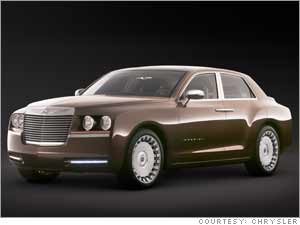
Some are impressed with the Chrysler Imperial concept car unveiled in January this year at the North American International Auto show. From MercuryNews.com:
The idea here is to question whether there's space in the Chrysler lineup above and beyond the iconic 300C sedan. The Imperial is a huge, tall car, as in 17 inches longer and six inches taller than a 300. It's an evocative statement similar in its classical stance to such popular Chrysler concepts as the Atlantic from 1995. Most, though, see the current Rolls-Royce Phantom when they see the Imperial concept. (Not coincidentally, many see a Bentley when they see Chrysler's 300 sedan.)All I know is, Chrysler seems to be batting 1000 when it comes to cool car design and production. Or maybe it's all in the marketing?
Reaction to the Imperial has been mixed. Dan Lienert on Forbes.com proclaimed it one of the year's 10 coolest concepts and characterized it as ``another stab from Chrysler at bringing sinister looks back into American sedans.'' But Motor Trend wrote that the ``Detroit show reaction can be most charitably described as `lukewarm,' with one wag describing it as a cross between the Rolls Phantom and the Checker Marathon.''"
Tags: chrysler imperial, chrysler concept, imperial concept, concept car, chrysler, rolls royce phantom
Subscribe to:
Posts (Atom)